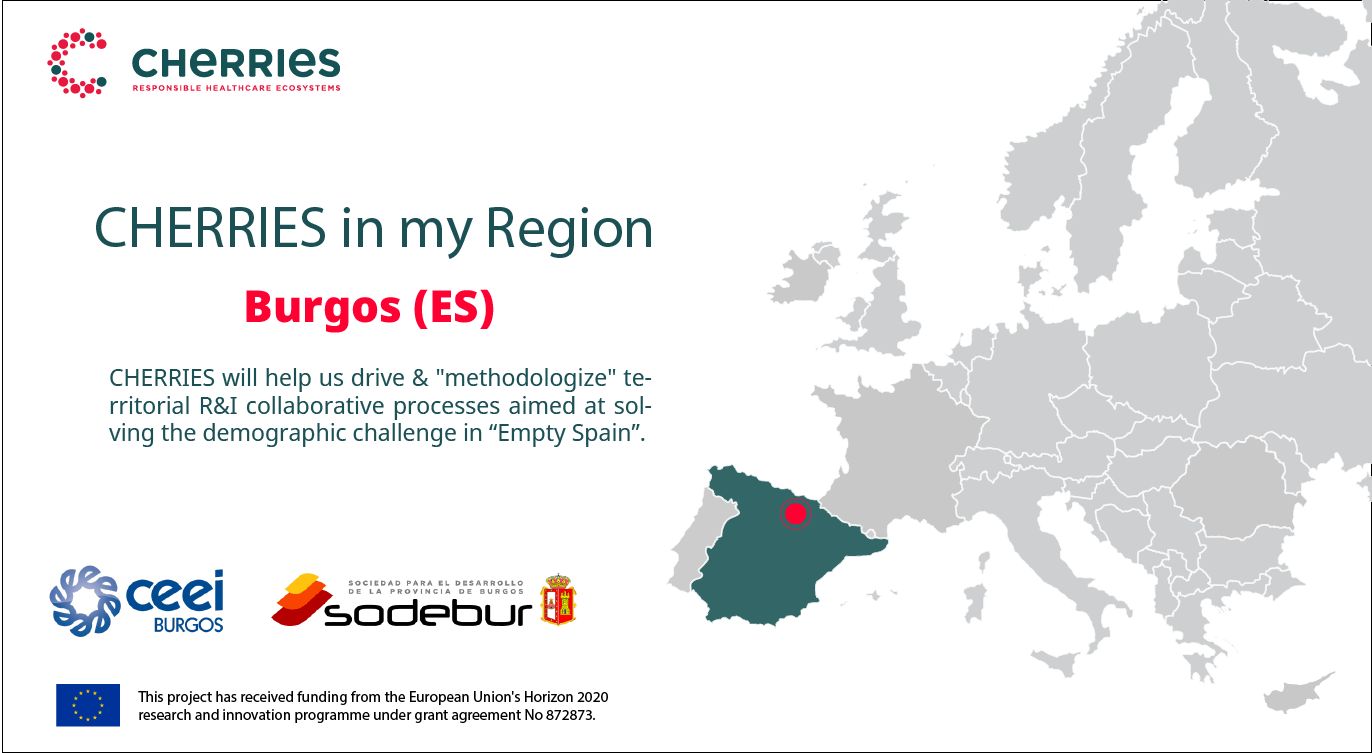
Let us take you to a journey into the CHERRIES Mirror Regions – 4 European territories that almost 1 year ago joined our community to receive coaching and mentoring support to replicate and adapt CHERRIES methodology into their local ecosystem and strategic R&I sectors. Let’s start from CHERRIES MIRROR REGION BURGOS – Spain.
About Burgos Mirror Region – short overview
- Priority Area addressed by the region in the framework of CHERRIES: Housing Rehabilitation in Rural Areas
- Partners: CEEI Burgos, Provincial Government of Burgos (SODEBUR) and City Council of Burgos
- Why CHERRIES? “SODEBUR usually implements its mission in close cooperation with other entities and stakeholders involving them both in the identification of needs of the province and in the development of possible solutions. CHERRIES will help drive, “methodologize” and formalize these processes. The CHERRIES approach is revealed as especially interesting at present since SODEBUR is finalizing a new Strategic Plan for the period 2021-2025 in which RRI-driven dynamics can play a role in addressing numerous issues that are mentioned in the new provincial strategy for the considered period”.
Why did you join the CHERRIES Community? What did you find interesting and relevant for you in the CHERRIES methodology?
SODEBUR is more and more enabling participatory processes at territorial level to identify challenges and solve them. The CHERRIES approach is a good framework to develop and foster consensual processes to diagnose and identify problems, bottlenecks, opportunities and agents that contribute building strategic planning for the development of the province. Moreover, CHERRIES’ approach is also going to be tested in the dynamics of implementation of the policies, programs and actions derived from the Strategic Plan for the period 2021-2025.
What are the main challenges your territory is currently facing and addressing with innovative R&I strategies?
In a territory as extensive as Castilla y León, with nine provinces, and a large part of the population living in rural and dispersed environments, the alignment of the respective strategies of the different public agents is essential and thus the strategic planning of the province is a priority. The new smart specialization strategy of Castilla y León has – among its objectives- a strong focus on the demographic challenge, which has a special impact on the rural areas of the Community.
The issue of rural housing in a province like Burgos (and in the provinces of the interior of Spain or the so-called Empty Spain) is really important because although a priori there would be many houses in all localities, it has been detected that there is no housing available to move into and therefore the demographic challenge is affected. Accommodation is revealed as an important factor to “fight depopulation” and address the so-called demographic challenge in “Empty Spain”.
The issues that we consider would be related to housing in rural areas are:
- Fast and sustainable construction solutions for the rehabilitation of rural housing.
- Financial solutions for the rehabilitation of rural housing.
What are the next steps the region will undertake to meet the demographic challenge?
SODEBUR might plan to use their own funds of the assigned budget or the own budget of the Diputación Provincial to address the demographic challenge of the region. SODEBUR is also encouraging the inter-institutional collaboration of the regional government to improve financial solutions, actions or policies to solve the main challenges.
CHERRIES’ approach will help drive and “methodologize” or formalize these processes. While finalizing a new Strategic Plan for the period 2021-2025, SODEBUR believes that RRI-driven dynamics can be incorporated in addressing numerous issues that are addressed in the new provincial strategy.
Watch the interview with Javier Sardiñas from CEEI Burgos