By being a part of the CHERRIES family, we gain insightful know-how in order to replicate the model in our region, which is an added-value for both the innovators and the beneficiaries (the medical staff and the patients), or, in other words, a gain for the development of the regional medical system.
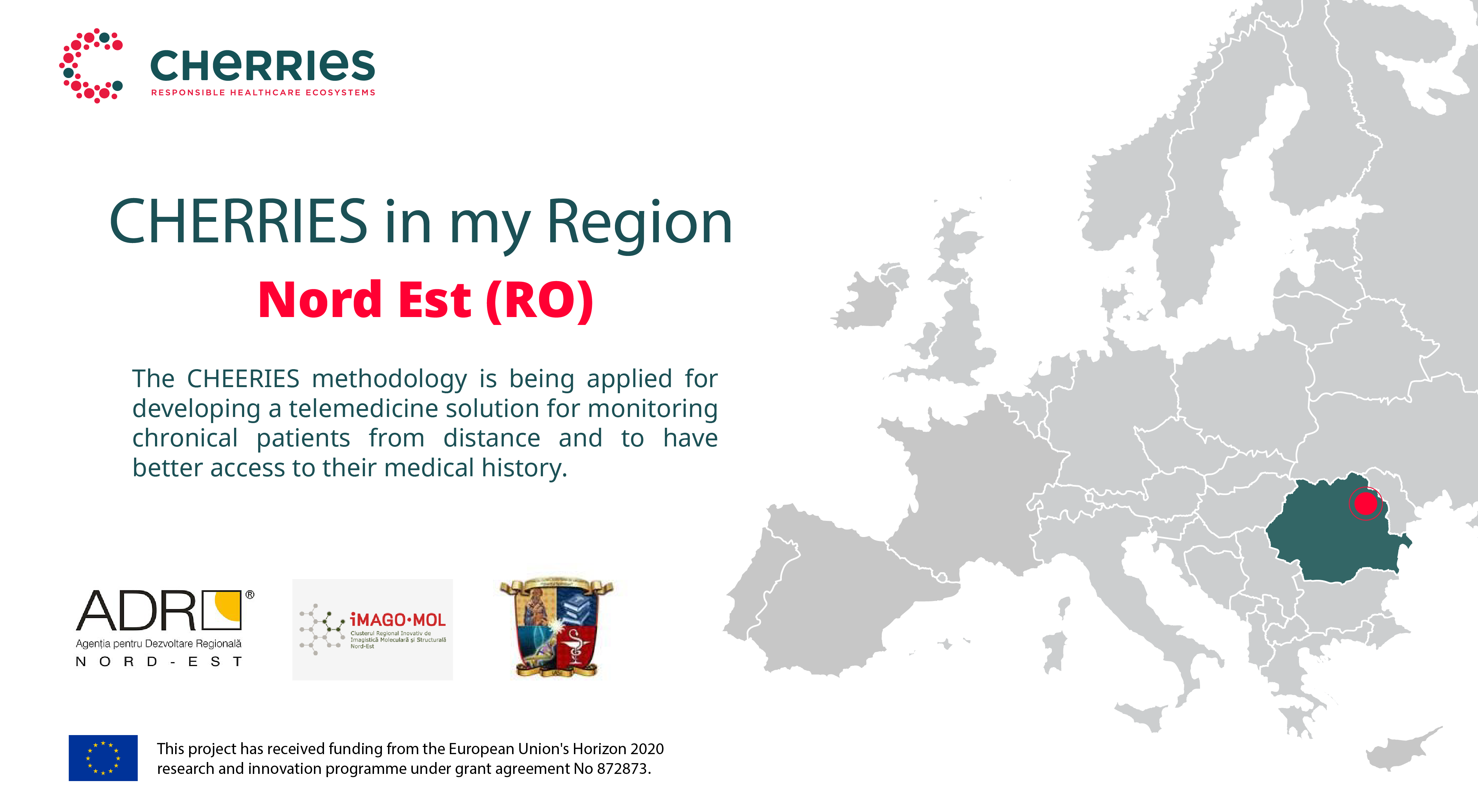
The journey into the CHERRIES Mirror Regions continues. Today we present you how the Northeast region of Romania is replicating and adapting CHERRIES methodology into their local ecosystem and strategic R&I sectors.
- Partners: NE RDA, Imago-Mol Cluster and the ”St Spiridon” Emergency Clinical Hospital.
- Priority Area: The CHEERIES methodology is being applied for developing a telemedicine solution for monitoring chronical patients from distance and to have better access to their medical history.
Why did you join the CHERRIES Community? What did you find interesting and relevant for you in the CHERRIES methodology?
Even though our region is not very well situated in the European Regional Innovation Score, the potential for innovation is increasing rapidly and we would like to foster this process by giving the best support we can to our innovators. As part of our continuous efforts in this area, we wanted to become a Mirror Region, in order to gain insightful know-how on the methods through which we could involve the quadruple helix in developing tailor-made solutions for our regional needs. By applying the CHERRIES methodology, we offer to our regional actors a new perspective on the co-creation process and we hope to increase the engagement of interested parties (both providers and beneficiaries).
In order to test CHERRIES methodology, the NE RDA is working closely with the Imago-Mol Cluster and one of its founding members, the “St. Spiridon” Emergency Clinical Hospital.
A questionnaire was distributed to the medical staff of St. Spiridon Hospital, as a pilot hospital, and to patients’ associations in the region, therefore, 34 responses have been received. The information gathered from these responses will be used to identify the needs of hospital patients and professionals. For doing so, a selection committee will be made up of representatives from each member of the CHERRIES Northeast Mirror Region Consortium (NE RDA, Imago Mol Cluster, and St. Spiridon Hospital).
Through the survey, the needs that have been identified within the medical community in the Northeast region range from streamlining intrahospital bureaucratic processes, and implementing remote patient monitoring solutions, to implementing telemedicine solutions. The main beneficiaries of these initiatives will be both patients and medical staff, as the adoption of these solutions will help to shorten the time of reaction, increase the quality of healthcare services, and ease the access of patients to such services.
What are the main challenges your territory is currently facing and addressing with innovative R&I strategies?
It is important to highlight that there are still some challenges to face before adopting these solutions, including reluctance, bureaucracy, and lack of material resources.
An important challenge is to stimulate the proactivity of the civil society within the co-creation process, as it is a new concept, and we have to overcome the reluctance of some with solid arguments about the added-value co-creation and RRI bring to the innovation process.
Besides that, the main challenge is related to raising funding resources for the implementation of the pilot project.
As Romania is a centralized country, we do not have a regional budget in order to allocate some specific funds for the implementation of this type of projects and we have to find an external budget for the development of the solution for the identified need.
Specifically, one possible source of funding for this initiative is the PNRR (Recovery and Resilience Plan for Romania), which has a call code of MS-733. This funding is specifically intended for investments in IT systems and digital infrastructure of public health units and is available to a wide range of eligible beneficiaries, including public health units subordinated to UATs, partnerships between central and local public authorities and institutions, and other central public authorities and institutions.
In addition to the PNRR, there may be other sources of funding available to support the medical community in the Northeast region. The selection committee will need to review all potential funding options carefully and determine the best course of action to secure the necessary resources aligned with the solutions matching the identified needs. By working together and leveraging available funding opportunities, it is hoped that the medical community in the Northeast region will be able to address the needs identified through the CHERRIES methodology, which in turn will help to improve the health and well-being of the local community.
What are the next steps the region will undertake to meet the demographic challenge?
In the coming weeks, our intention is to define, develop and launch the call for solutions and, in the same time, to continue our search for funding opportunities for the pilot project, considering structural funds. Also, we intend to promote the CHERRIES methodology among Imago-Mol members in order to attract possible companies that would be interested to develop a solution for the identified need.