Regional innovation ecosystems for healthcare | Insights from CHERRIES webinar #4

How does RRI (Responsible Research and Innovation) fit into Regional Innovation Smart Specialisation Strategies (RIS3)? How can European Regions leverage their diversities to boost innovation?

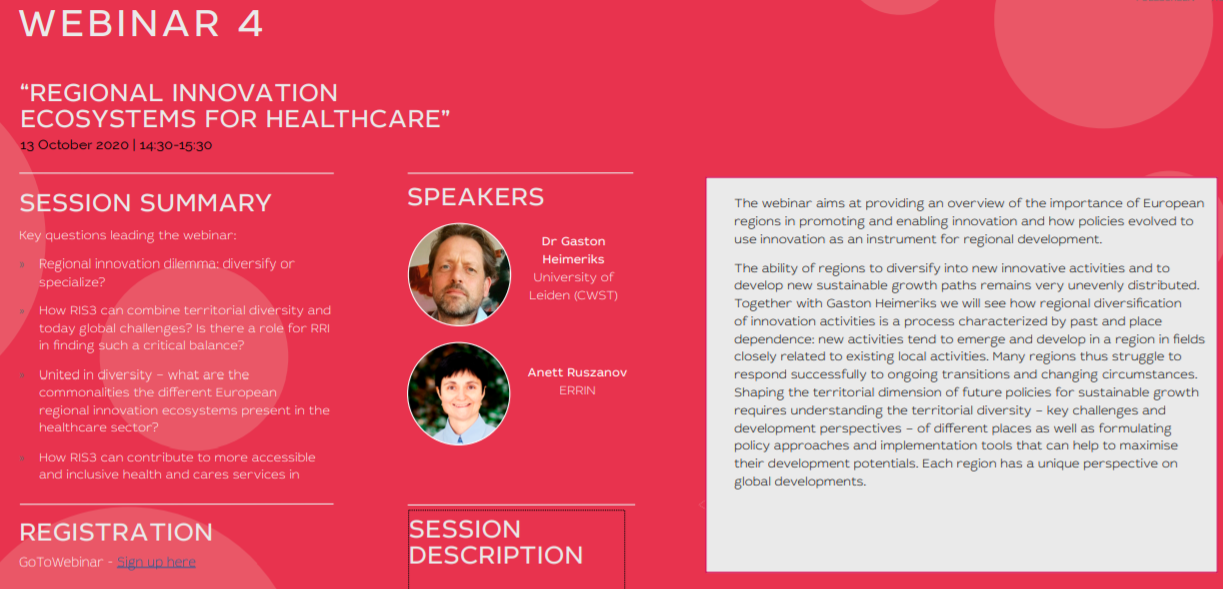
This question opened the 4th and last episode of CHERRIES webinar dedicated to “Regional innovation ecosystems for healthcare”, which took place on October 13th 2020, and saw Dr. Gaston Heimeriks (CWTS, Leiden University| Copernicus Institute, Utrecht University) and Anett Ruszanov (ERRIN) on stage.

Gaston Heimeriks opened its presentation with a reflection on how regions can shape not only smart innovation strategies, but also inclusive and sustainable – in other words, responsible smart specialisation innovation strategies. He then presented the role regional stakeholders play in enabling such a responsible approach: mapping regional policies and regional actors is a key starting point to shape regional innovation policies that can better address today societal challenges.

Anett Ruszanov then dived into the role regional ecosystems play in/for the healthcare sector. Diversity is a must at subnational levels, such as the regional one. Each region presents its own innovation ecosystem, with its model and processes. Anett spoke about the dynamism of innovation ecosystems that are in constant evolution and presented how different regions present different approaches to meet societal needs.

The session was closed by CHERRIES coordinator, Stefan Philipp (ZSI) who made some considerations on the main outcomes of the whole CHERRIES webinar series.

If you missed the session you can watch the recordings here.

You can also download the presentations here:

Don’t forget to subscribe our newsletter and follow us on Twitter and LinkedIn (@CHERRIES_eu) to check latest updates from our community!
The role of procurement in healthcare innovation | Insights from CHERRIES webinar #3

The third episode of CHERRIES webinar series -held last October 6th- tackled the topic of innovation procurement in the healthcare sector.

The first two episodes set the scene on demand-driven innovation policies and responsible healthcare ecosystems and in both occasions a question raised up: the innovation frameworks are changing towards more responsible and sustainable approaches, but are rules ready enough to support this cultural change? Is the regulatory framework advanced enough to cope with the complexity of the health sector?

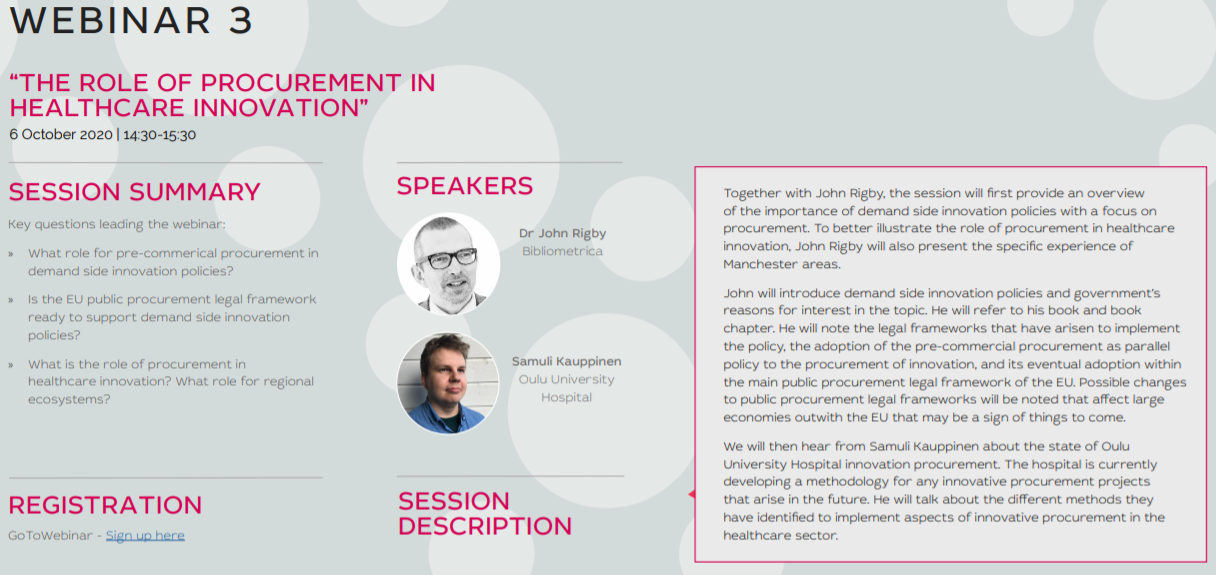
Dr. John Rigby and Samuli Kauppinen debated these questions in their speeches.

Dr. Rigby stated that “innovation is a conversation” where different actors need to interact and exchange. In other words, procurement serves and articulates the demand side of the innovation chain and therefore greater connectivity among health stakeholders is needed.

He then brought some concrete examples from the UK context, with a focus on the Health Innovation Manchester experience.

Samuli Kauppinen spoke about the public procurement of co-created innovative solutions, and he built his speech around the current experience of Procurement of Innovation in the Northern Ostrobothnia Hospital District. He presented how the InDemand project kick started some reflections on how to support the adoption of solutions resulted from co-creation approaches, and the implications from a procurer’s perspective. Samuli presented the process the Hospital has designed and the plans for its actual implementation.

If you missed the live session, you can still watch the recordings here.

You can also download speakers’ presentations:

CHERRIES webinar 3_John Rigby_UoManchester

CHERRIES webinar 3_SamuliKauppinen_NOHD

Cherries_eu_webinar series_EP3

RRI practices in healthcare | Insights from CHERRIES webinar #2

Is the RRI framework advanced enough to manage the complexity of healthcare innovation ecosystems?

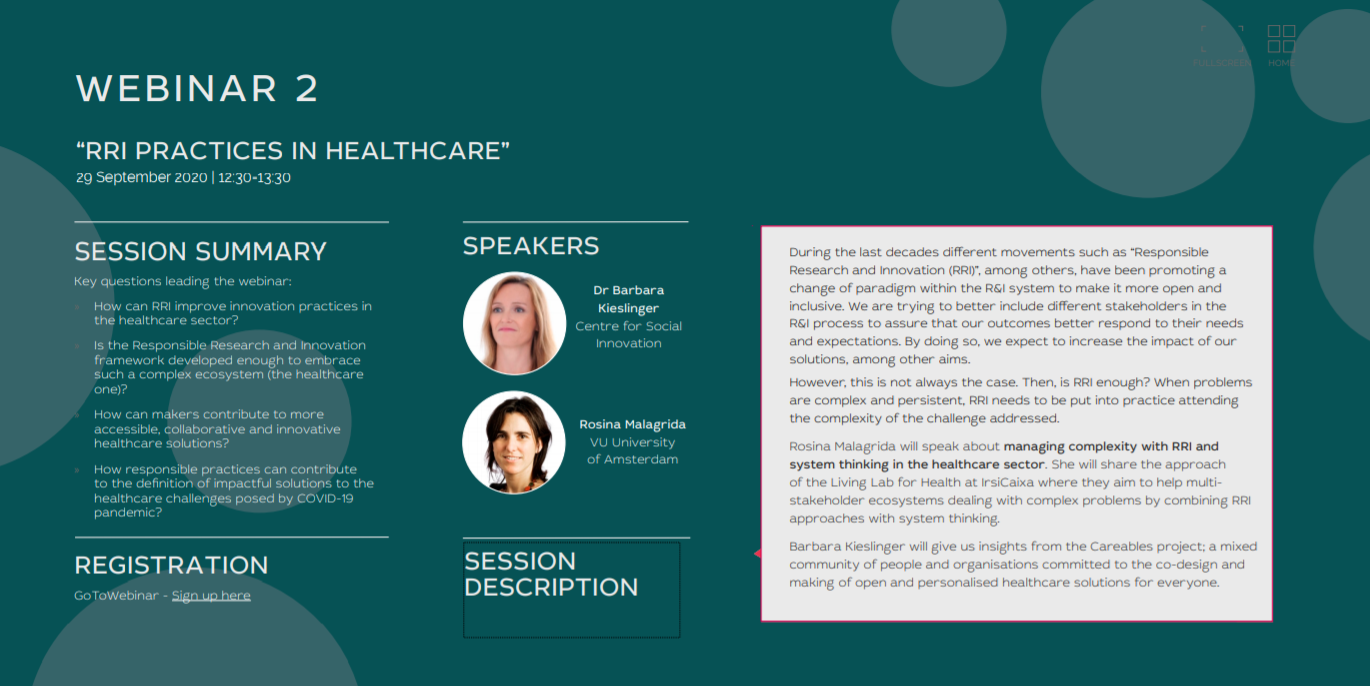
This question kick started the second episode of CHERRIES webinar series “Exploring Responsible Healthcare Ecosystems”. Held on September 29, this session focussed on RRI practices in healthcare and saw two experts on our “virtual stage”: Rosina Malagrida, Head of the Living Lab for Health at IrsiCaixa & Co-coordinator of the Barcelona “la Caixa” Living Lab, and Barbara Kieslinger, Coordinator of Careables.org and Project Manager at the Centre for Social Innovation – ZSI, Vienna, Austria.

Two totally different approaches were presented during the webinar.

Rosina Malagrida spoke about the complexity that characterizes the healthcare sector and the need for a new problem solving approach where different stakeholders of the ecosystem are involved throughout the whole innovation chain, from challenge definition to solution implementation. In this context, RRI can help regional actors to act at ecosystemic level, rather than project level to generate a real impact with and for society, moving from an organisational perspective to a community one.

Rosina presented how linear thinking is not enough to embrace such a complexity, while systemic thinking can help identifying root causes and mapping interconnections. She also elaborated on the role intermediaries should play in establishing a dialogue between society and the R&I community.

Download here Rosina Malagrida’s presentation: 01_RRI_Cherries_Webinar_Sept2020_Malagrida

Barbara Kieslinger presented the Careables.org platform, a mixed community of people and organisations committed to the co-design and making of open, personalised healthcare for everyone, born from the EU-funded collaborative H2020 project Made4You.

She presented how Careabes.org embedded key dimensions of the RRI framework in its methodology and practices, and the result is a set of “responsible making principles”:

  1. Make things that make sense: Create solutions that answer to real personal problems or needs.
  2. Co-design with others: Make space for diverse skills, competences, knowledge, and experiences to merge and come to new and meaningful solutions.
  3. Empower people: Teach others so that everyone can become more technologically literate and see the potentials.
  4. Share How You Make: Openly document the making of the project enabling its replication and choose the most appropriate licenses for your project.
  5. Be aware of limits: Consider any gaps of knowledge when you design for health and care, ask the people you design for and clinicians for support and feedback and follow quality and safety standards.

Barbara then elaborated on the legal and ethical aspects that influence the work makers do when developing healthcare and medical solutions/devices.

Download here Barbara Kieslinger’s presentation: 02_Cherries_Webinar_Sept2020_Kieslinger

This is in a nutshell what was discussed during the 2nd episode of CHERRIES webinar series “Exploring Responsible Healthcare Ecosystems”.

You can watch the full episode here

If you want to know more about CHERRIES and our webinar series download this presentation: Cherries_eu_webinar series_EP2


Next Episode is on October 6th at 14.30 CET, don’t miss it!

Episode 3. The role of procurement in healthcare innovation
With Dr. John Rigby (University of Manchester | Bibliometrica Ltd.) and Samuli Kauppinen (Oulu University Hospital)