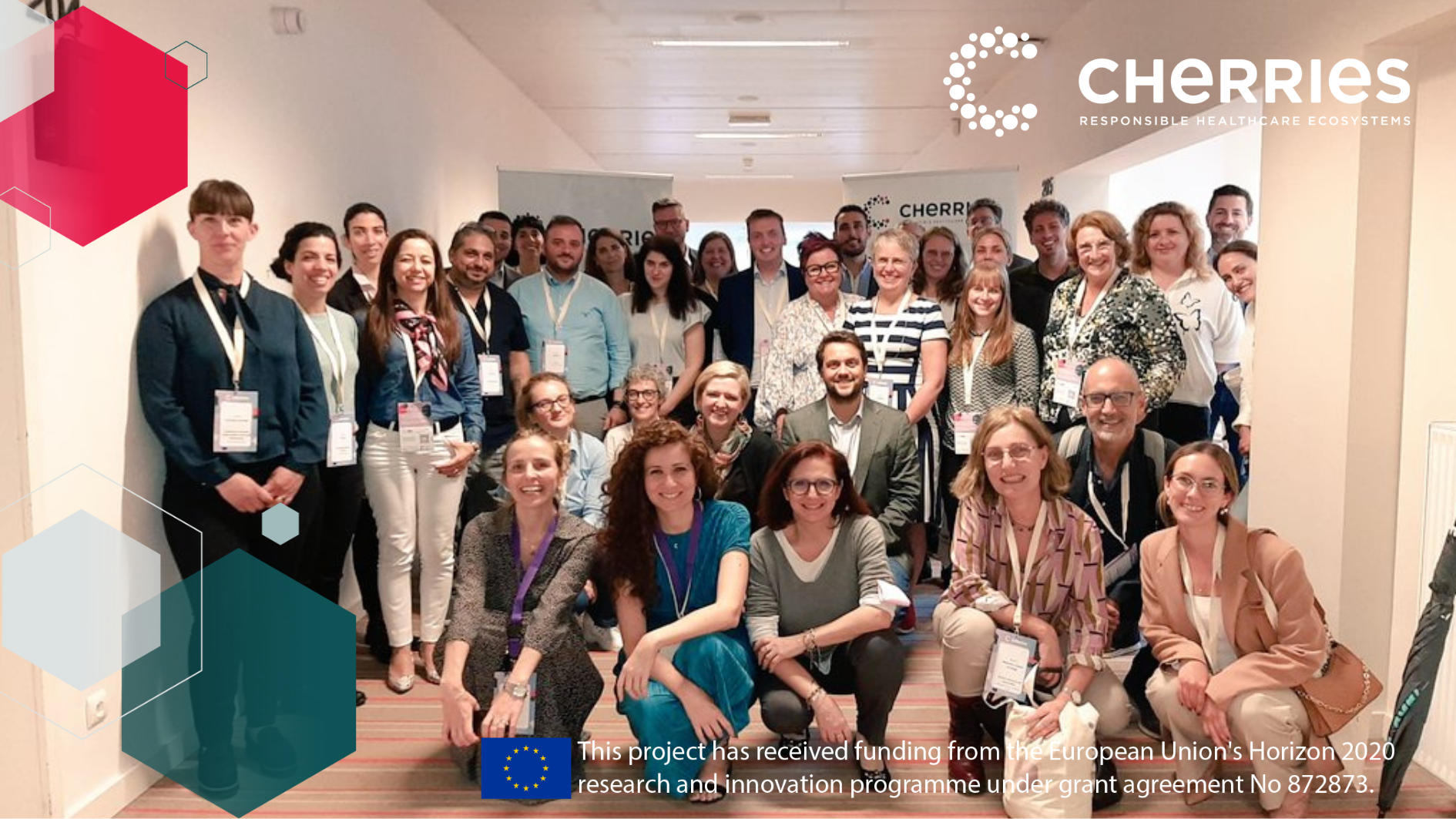
“Connecting Responsible Innovation Ecosystem” is the title of a 2-day event dedicated to the CHERRIES community that was finally meeting in person to discuss main outcomes of two years and half of project activities and exchange on the way forward.
On May 24 and 25, CHERRIES Community gathered in Brussels to discuss connecting responsible innovation ecosystems, with a particular emphasis on the healthcare sector.
The first day of CHERRIES conference was designed for consortium partners, regional stakeholders from the CHERRIES Pilot Regions (Örebro, Sweden; Murcia, Spain; Republic of Cyprus), and the CHERRIES Mirror Regions (Centro, Portugal; West of Ireland, Ireland; Nord East, Romania; Burgos, Spain) to debate the opportunities and challenges of designing and enabling Open and Responsible Innovation programmes, based on demand-driven innovation processes and co-creation approaches.
What is the benefit and need for changing the R&I culture in and between organisations? What is required and how do you initiate and manage these processes in the given regional systems?
Divided into two parallel tracks (one for the practitioners and one for the policy makers), participants discussed in an engaging format how CHERRIES methodology and outcomes can contribute to a culture change in regional R&I strategies.
To summarise the outcomes of the exchange between Pilot and Mirror Regions practitioners on CHERRIES methodology…
- It is not a recepy, it is a process
- It is an experiment & you need room for experimentation
- It is combining societal needs with regional R&I priorities
- It is unleashing innovation for unmet needs
On May 25th, the event was opened to a wider audience. Organised back-to-back to the EBN Annual Congress 2022 | Transition Towards 2030, CHERRIES conference provided participants with insights from project partners and their stakeholders on how the CHERRIES model contributed to shape regional “shared arenas for deliberation” as a means for needs identification and the way they are planning to transit “from regional pilots to sustainable actions”.
After an introduction about the project methodology by Stefan Philipp (ZSI), CHERRIES Pilot Regions shared key highlights from the regional implementation of the CHERRIES model. The 3 selected solution providers (SYSTSERV, Evidenze Digital Health – Pulso, and Southern Örebro County), shared their experience implementing co-creation processes aimed at designing and implementing innovative solutions to the regional challenges. The panel also focussed on how the pandemic changed their engagement and involvement with diverse stakeholder groups, given the evolving restrictions.
Through engaging parallel workshops, participants explored the “next generation of CHERRIES-model”, by integrating transition management thinking into Open Innovation 2.0 approaches. These workshops provided the opportunity for people coming from mirror regions and other projects implementing RRI and co-creation, such as TetRRIS, MOSAIC, WBC-RRI.NET, to share their experiences and best practices, and relate these to the challenges and successes of the CHERRIES project. Special attention was paid to the discussion on how to move from the operational level to the strategic level when implementing the model, throughout the process of assessing how to best replicate and scale up the most positive results.
For the second half of the public conference, CHERRIES event merged with the European Business Innovation Centre Network Annual Congress.
Nir Koren, CEO and founder of buildinn opened the afternoon with an engaging presentation on the connection between innovation and sustainability, and advocated for the need to think about sustainability not as an independent concept in itself, but to think about sustainability and innovation together.
The following session, “Responsibility and Sustainability – two sides of the same coin” was moderated by Lotta Karlsson-Andersson CEO of Activa Foundation.
During this session, Mr Marinos Portokallides, Scientific Officer at the Cypriot Research and Innovation Foundation, mentioned that “we should move from an industry-driven to more demand, responsible driven innovation”. In the panel, there was frequent mention of the need to engage citizens and a wider range of stakeholders, Cristiana Costa, Project Manager at Laboratory for Automation and Systems (LAS) of the Instituto Pedro Nunesby stressed the importance of making them aware of how R&I can improve citizens’ lives and society as a whole, and therefore calling everyone to contribute to territorial strategies and goals.
As stated by Ingeborg Meijer (CWTS Leiden) “We have developed an ecosystem of SwafS14 projects focused on territory. We found that there is no one size fits all. We can join the best of different, diverse worlds and find something in common.”
During the final session “Testing RRI and demand driven approaches to shape regional (smart specialisation) innovation strategies” moderated by Esther Peñalver Ibarra, Director CEEI Murcia, Nicola De Michelis , Director at DG Regio, discussed the future relevance of smart specialisation strategies. He suggested that while the strategies aren’t perfect, they do continue to offer enough value to continue to be in use, and that now is the time to engage with regional authorities to revise these strategies to be effective and sustainable in the coming years. Moreover, in line with RRI principles, he talked about the need to involve different stakeholders with different skills in order to bring together that collective knowledge, which allows organizations to be more demand-drive, and ultimately have a wider intake by the public. Douglas Robinson, Deputy Director of LISIS-CNRS shared some reflections about the overal CHERRIES conference and observed how the EU Missions represent a shared agenda between ecosystems and shareholders, capturing shared value. He also discussed how citizens, firms and other stakeholders could be incentivised to be involved in co-creation activities.
It was a dense programme, enriched by different territorial and sectorial perspectives and expertise.
The Conference, which originally was ment to take place towards the end of the project as a “traditional” final dissemination activity, turned out to be a fundamental milestone for the CHERRIES community. A community made of regional innovation ecosystems committed to embrace Open and Responsible Innovation approaches as a way to shape inclusive, sustainable and impactful territorial strategies.