What’s the future of Smart Cities? RRI2SCALE survey

Territorial trends, drivers and impacts in intelligent cities, transport and energy – this is what the survey proposed by RRI2SCALE project is investigating.

If you are an expert in any of the below domains:

  • Smart cities
  • Smart transport
  • Smart energy production and consumption
  • Regional Innovation Strategies for Smart Specialisation (RIS3)

please consider the opportunity to have your say.

The survey is conducted in two consecutive rounds. The first one takes place currently though this questionnaire, while the second will be sent to you on 23/11/2020.

During the second Delphi round, you will have the opportunity to revise your answers on the same questionnaire in the light of other participants’ views.

TAKE THE SURVEY NOW.

The survey will close on November 20th. For further info please contact Dr. Angelidou Margarita, mangelidou@qplan-intl.gr

CHERRIES regional calls for needs are open! Shape responsible healthcare ecosystems in Murcia, Örebro and Cyprus

CHERRIES territorial pilots kick started last week by launching the regional calls for needs.

The needs inventory is an important part of CHERRIES project as it determines the direction of the pilots that will be launched later on.

Do you see a need that needs to be met in the regional healthcare sector? Take your chance to influence and contribute in the project!
The CHERRIES project aims to find new, innovative solutions to meet health challenges through responsible and sustainable approaches.

The CHERRIES project takes a clear bottom-up perspective when developing new solutions to meet health challenges. This means that we call organizations as well as individuals and professionals who are directly or indirectly concerned by an issue to be involved in influencing. The opportunity to describe a need is therefore open to healthcare organizations, healthcare individuals and professionals and healthcare stakeholder organizations, private individuals, persons involved in civil society and officials within, for example, the municipality or region.

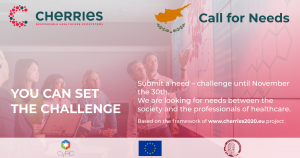
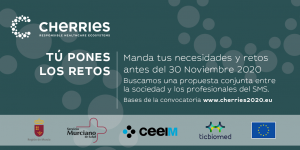
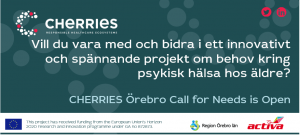
Each territory has adjusted the call to its peculiarities, therefore addressing different sub-sectors and target audiences. Look at each regional call and submit your need by November 30th

CHERRIES Cyprus

CHERRIES Murcia


CHERRIES Örebro


What happens next?

All needs reported via the form will be analysed and assessed. The assessment team will look, among other things, at the importance of the need, whether it affects many people, and whether it is possible to develop solutions and carry out a pilot project within the framework of the CHERRIES.

Any needs reported will help us increase our understanding of this issue, so even if the very need you report if not is the subject of a pilot project, it is valuable information for us in other work outside of this project!

CHERRIES Murcia | Jornada identificación retos salud 2

Murcia, 4 November 2020

CHERRIES Murcia organised the second regional info-session where our partners from Ticbiomed,  Servicio Murciano de Salud and the Region of Murcia presented (20201104_Agenda day 2 vs02):

  1. How to identify a need in the healthcare sector
  2. How to propose a need in the framework of CHERRIES programme- the regional call for needs will be launched shortly and will remain open until November 30th, 2020

CHERRIES regional calls for needs are the first step of our RRI and demand- oriented approach to inform and shape regional innovation policies and strategies (eg. smart specialisation) to better meet the current challenges healthcare innovation ecosystems are facing today in Europe.

Download here all presentations and watch the recording of the whole session:

If you missed the kick-off session in Murcia, you can check the recordings and the presentations here

Do not miss the launch of the call for needs in Murcia and register for CHERRIES Newsletter.

Mission-driven Health Ecosystems | CHERRIES session at EBN Congress 2020

On 3 and 4 November 2020, our partner EBN – European BIC Network held its annual congress, this year dedicated to “Regional Ecosystems Shaping European Innovation”, which gathered online more than 510 participants.

During the first day key note speakers and panelists focussed on regional ecosystems and the role intermediaries can play in boost innovation processes in and across territories. The second day “innovation mission-driven approaches” guided the conversations with key note speakers and panelists. On this second day, CHERRIES inspired and promoted a workshop dedicated to “Mission -driven Health Ecosystems. From abstract Responsible, Research and Innovation practices to concrete business action”.

Moderated by Moyses Moyseos Μωυσής Μωυσέως from CyRIC (Cyprus) the panel provided very interesting insights and reflections on how the sector is going through this transition phase caracterised by pressing societal challenges (aging society, COVID-19, increasing costs of the sector) which are somehow accelerating the transition towards more sustainable innovation approaches.
Lydia Montandon (Atos Spain), Magda Krakowiak (EIT Health) John Rigby  (University of Manchester and CHERRIES Advisory Board Member) discussed challenges and opportunities of the digitalization of the sector, the need for new “rules of the game” (procurement should go beyond the technology itself and involve the processes that lead to those new technologies), the role different societal actors have in the health ecosystems and the consequent question on liability in such a changing system.
Complexity is definitely a keyword when speaking about innovation in the health sector, Responsible and Value Driven Innovation approaches can definitely help in managing such complexity and intermediaries such as EU|BICs can play a role in there.

Panelists then engaged in a networking session with Congress participants, where Covadonga Rayon from CEEI Murcia (Spain) also presented its experience and highlighted the importance of a cultural shift towards a more participated and inclusive healthcare system – where everybody is called to action, patients, practitioners, policy makers, entrepreneurs and intermediaries.

The importance of communication in the healthcare sector’s complexity | Take-home messages from CHERRIES webinar series 2020

CHERRIES Webinar Series 2020

Last September and October 2020, we organised a series of four webinars aimed to discuss different aspects of responsible healthcare innovation covering dimensions that are central for the CHERRIES project. In a format designed by EBN, theoretical and practical perspectives were combined in order to provide well-grounded yet practical information to our diverse set of stakeholders and to discuss how to address these sectoral facets in the context of a complex system like healthcare one.

We asked CHERRIES coordinator, Stefan Philipp (ZSI), to comment the whole series highlighting main outcomes and key reflections that will be further explored during CHERRIES territorial experiments. Below his highlights and take home messages.

The health sector is facing several challenges that are pushing for significant changes: aging population, increasing prevalence of chronic diseases, comorbidities, access to healthcare services in COVID-19 era, just to mention a few. At the same time, healthcare provision systems are facing constant pressure to reduce costs while improving quality. Thus, healthcare decision-makers increasingly recognise the potential of innovation to help respond to the challenges they face and to support high quality, safe, and effective care.

Therefore, the first webinar with the speakers Wouter Boon (University of Utrecht) and Myriam Martin (ticbiomed) focused on role of need in open and user-led innovation approaches in healthcare. Questions were revolving around need identification between actors with different perspectives and the implementation of innovation cultures in and between organisations.

In the second webinar, Rosina Malagrida (Head of the Living Lab for Health at IrsiCaixa) and Barbara Kieslinger (ZSI) explored how RRI and maker approaches contribute to manage the complexity that innovation in the healthcare are facing. The main points stressed were that RRI and co-design help to create real impact with and for society, moving from an organisational perspective to a community one.

During the third webinar, with the speakers John Rigby (University of Manchester; Bibliometica) and Samuli Kauppinen (Oulu University Hospital), questions of demand-side policy and public procurement of innovation have been discussed with insights from the Manchester area and the development of  a new procurement programme at the Oulu University Hospital.

The fourth and final webinar, focused on regional innovation policy and eco-system approaches in the context of European cohesion and healthcare policy with inputs from Gaston Heimeriks (Leiden and Utrecht University) and Anett Ruszanov (ERRIN). Questions of governance and the importance of networks, both within and beyond the regional boarders, have been discussed in the context of the regional potential to specialise in specific sectoral niches and technologies.

Reflecting the eight inputs and subsequent discussions, two themes emerge as shared experience.

First, the complexity of the sector that makes it impossible for a single actor or organisation to have a comprehensive overview of all processes running in parallel within a healthcare (innovation) system – John Rigby even described the sector as a jungle rather than a system. This complexity is necessarily leading to distributed governance structures that pose the risk of silos and poor alignment between system elements.

In direct connection to that, the second theme has been the importance of communication. The distributed knowledge about the sector’s needs implies that agency – understood as the ability to act within the system – must be understood as a collective effort. The constant enhancement and adaption needed to support high quality, safe, and effective care thus is depending of communication processes. These communication processes include patient – general practitioner, general practitioner – specialist, specialist – hospital management, hospital management – innovative SME relationships and many more communication processes that contribute to effectively translating needs to innovative solutions that are well aligned with organisational and technological requirements as well as with societal expectations.

In the CHERRIES project, we aim to support regional ecosystems with these alignments and will work to support communication processes within and between regions. We recently published the call for needs aiming at regional eco-systems to reflect, identify and communicate issues within or connected to the healthcare system that are affecting either the healthcare service delivery quality, or creating avoidable costs within the healthcare system, or both things at once. Subsequently, we will develop solutions aiming to solve selected needs in co-creation processes – thereby to work towards opening of communication processes and alignment of innovative solutions with specific requirements in a complex system.
CHERRIES Murcia | Jornada identificación retos salud 1

Murcia, 28 October 2020

Last week CHERRIES kicked off its regional activities with the first info-workshop in Murcia: “Cómo me puedo beneficiar de CHERRIES” (20201028_Agenda day 1).

Download here all presentations and watch the recording of the whole session:

Do not miss the next session organised by our partners in Murcia on November 4th.

Discover CHERRIES call for needs, the first step of our RRI and demand- oriented approach to inform and shape regional innovation policies and strategies (eg. smart specialisation) to better meet the current challenges healthcare innovation ecosystems are facing in Europe

The RRI-based open-innovation experiments (Labs) are conducted in three European regions – in Murcia (ES), Örebro (SE) and the Republic of Cyprus (CY). The regional eco-systems will identify, co-create and implement innovative solutions addressing the sectors’ needs.

Based on a common methodology, each Lab will consist of 3 main phases:
1. Call for needs: we call patients and citizens, medical professionals, healthcare institutions and other relevant territorial and societal actors to express their needs
2. Call for solutions: we call European entrepreneurs and social innovators to answer regional needs with their innovatove solutions
3. Co-creation: we support selected entrepreneurs to co-develop their solutions in close collaboration with the key stakeholders of the regional healthcare ecosystem
The RRI experimentations will inform CHERRIES policy recommendations.